Features
Everything needed to produce a reviewable draft
Everything below is something the platform does today — not a roadmap, and not a promise about what is coming.
Ingestion and early validation
Three ways in for a trial balance
Upload an Excel or CSV file in any column order, fill in the platform's signed template — which refuses any structural edit — or pull directly from a connected accounting system.
Safety nets before any processing
Balance checks, duplicate accounts, empty rows and implausible balances, with a validation report that points at where each finding sits in your original file.
Column recognition
Each column's meaning — account code, name, debit, credit — is proposed and confirmed by you before import, and the choice is saved as a profile for next time.
Mapping and review
A fixed resolution order
Your firm's memory first, then the defined rules, then an AI suggestion where one is needed — in a stated order, with each source labelled plainly on screen.
A gate before confirmation
Statements cannot be generated while a single account is unresolved. The gate is enforced on the server, not only in the interface.
Memory at two levels
A mapping decision is remembered for that client and for the whole firm, so reliance on AI suggestions falls with every additional year.
Policies and notes
A ready accounting-policy library
Pre-drafted policy text in Arabic and English, included automatically according to the line items that actually appeared in the trial balance.
Variables instead of repeated prose
Useful lives, measurement bases and the like are declared as variables filled in per engagement, rather than a paragraph re-edited every time.
Your own wording where it matters
A firm can replace the wording of any policy or add its own note, with any deviation from the master text shown plainly.
What the Saudi environment requires
Zakat or tax by ownership
The treatment is derived from the entity's ownership structure — Saudi/GCC, foreign, or mixed — so a zakat provision, an income tax provision, or both appear, each with the note that belongs to it.
The statutory reserve
The transfer to the statutory reserve is computed at the rate and cap set for the entity's legal form, and shows up in the statement of changes in equity and in the financial position together.
End-of-service benefits
Presented as a non-current liability with its measurement policy note — one of the items most often missed when a set is prepared by hand.
Bilingual output
Each caption in Arabic and English on the same line, with Western numerals correctly aligned inside Arabic text — in PDF, Excel and Word alike.
Generation and export
A complete statement set
Statement of financial position, profit or loss and other comprehensive income, changes in equity, cash flows on the indirect method, and the notes.
An accounting validation battery
Trial-balance balancing, rollup integrity, the financial-position balance, the equity reconciliation and the cash-flow tie-out — and any hard failure blocks generation and is explained in both languages.
Three formats from one source
PDF, Excel and Word are all rendered from the same model, so the figures cannot differ between them under any circumstances.
Preview before payment
The full draft is shown watermarked before payment; paying unlocks only the clean copy.
Operations and governance
Roles and permissions
Firm owner and staff, with different rights, and complete isolation of each firm's data from every other.
An append-only audit log
Every sensitive action is recorded with its actor and time, and cannot be edited or deleted afterwards.
Wallet and invoices
Top up, draw down on unlock, and a clear transaction history for every movement.
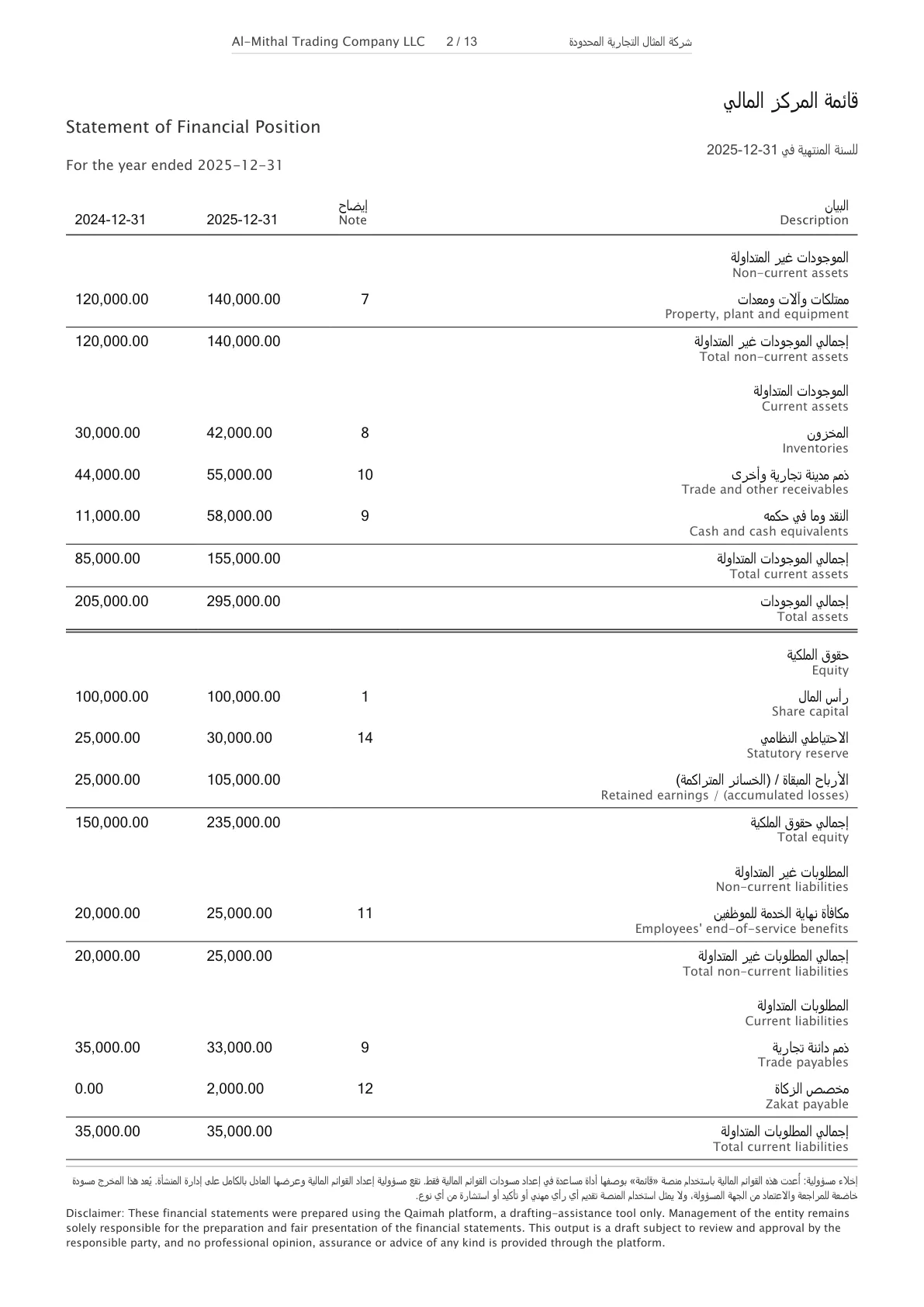
The images on this page are not artwork
Every image here is a real page from a set the platform produced from a sample trial balance, and that passed the full accounting validation battery before it was rendered.
All three formats — PDF, Excel and Word — are rendered from one model and no figure is recomputed in any of them, so the numbers cannot disagree between files.