From a trial balance to a complete draft set of financial statements
You upload the trial balance and review how every account maps to its line item and how each accounting policy reads. Qaimah does the arithmetic and the presentation: financial position, profit or loss and other comprehensive income, changes in equity, cash flows and the notes — Arabic and English in the same document. The review and the approval stay with you.
Full preview before you pay — nothing leaves your wallet until you have seen the draft.
- IFRS as endorsed in the Kingdom of Saudi Arabia
- Issued by the Saudi Organization for Chartered and Professional Accountants (SOCPA)
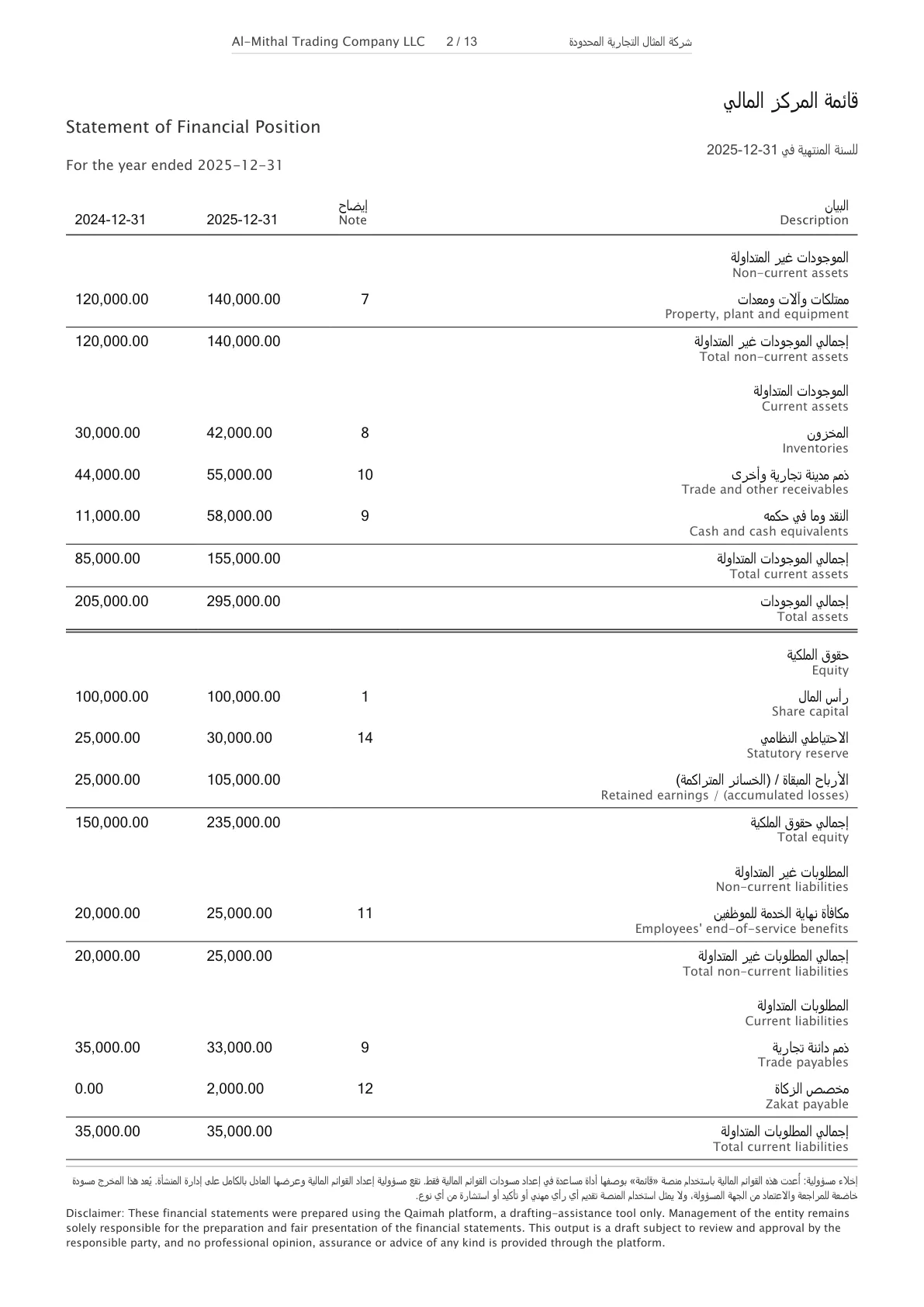
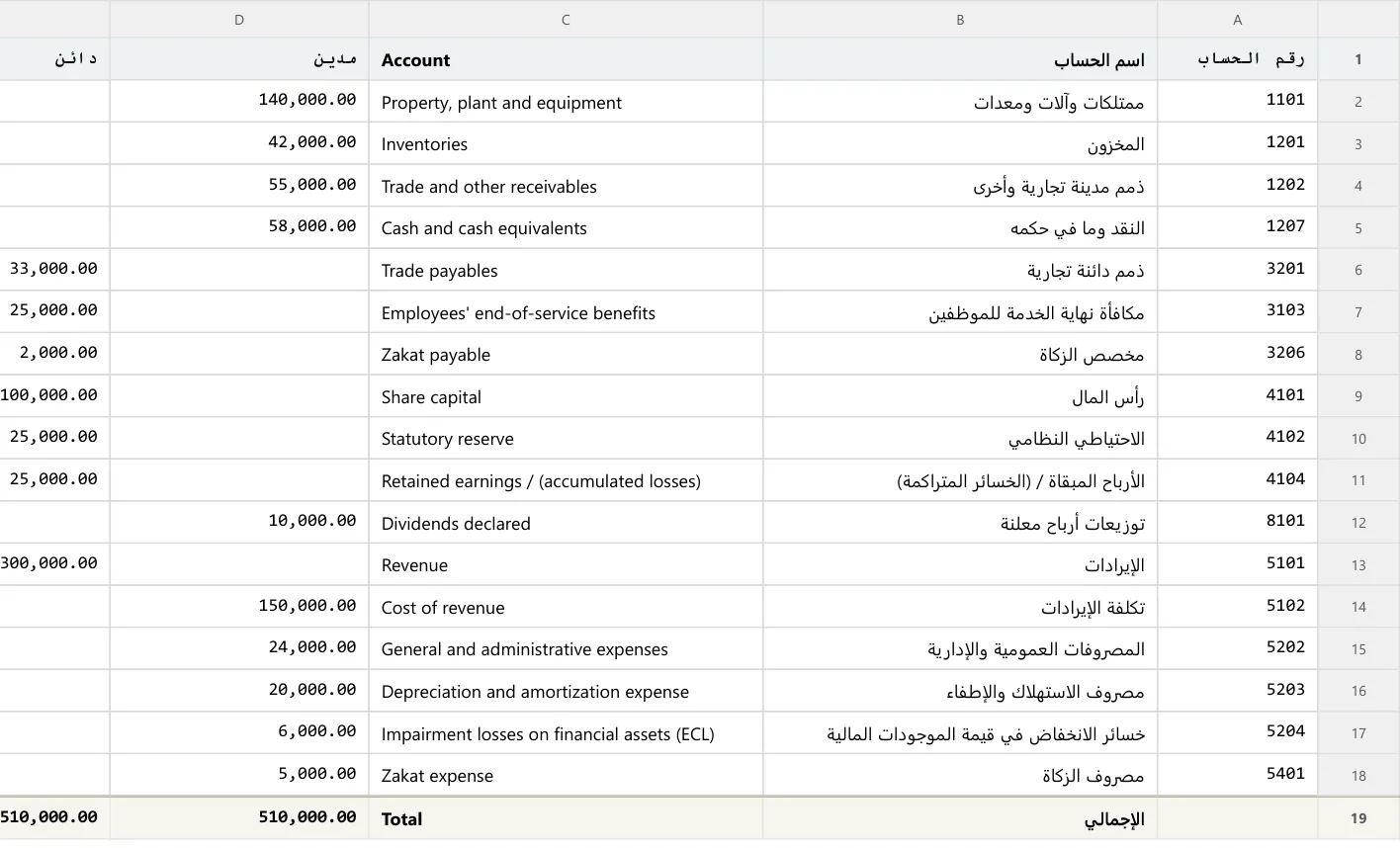
The output
What comes out of the platform
A complete set of financial statements, each with a condition the platform checks before it will produce anything at all. The line beside each statement is what has to hold — not a marketing claim.
Statement of financial position
assets = liabilities + equity
Profit or loss and other comprehensive income
revenue − expenses = profit for the year
Changes in equity
closing balance = equity in the financial position
Cash flows — indirect method
net movement = change in cash and cash equivalents
Notes to the financial statements
every presented line, its own note
All three formats — PDF, Excel and Word — are rendered from one model and no figure is recomputed in any of them, so the numbers cannot disagree between files.
The steps
Four steps, and one reviewable result
The longest part of preparing a set of financial statements is not the professional judgement — it is the copying, the formatting and the reconciling. These four take on that part only, and nothing in them produces a figure you have not seen.
Create the engagement
The entity's name, legal form and ownership structure, its fiscal year, and the reporting framework: full IFRS or the standard for small and medium-sized entities.
Bring in the trial balance
An Excel or CSV file in any column order, the platform's signed template, or a direct pull from a connected accounting system. It is checked for balance and completeness before anything is processed.
Review the mapping and the policies
Each account is proposed a line item — from your firm's own memory first, then the defined rules, then an AI suggestion — and the last word is yours. Nothing generates while one account is unresolved.
Preview, then export
The complete draft is in front of you, watermarked, before you pay; the clean export to PDF, Excel and Word then unlocks from your firm's wallet.
From the output itself
The images on this page are not artwork
Every image here is a real page from a set the platform produced from a sample trial balance, and that passed the full accounting validation battery before it was rendered.
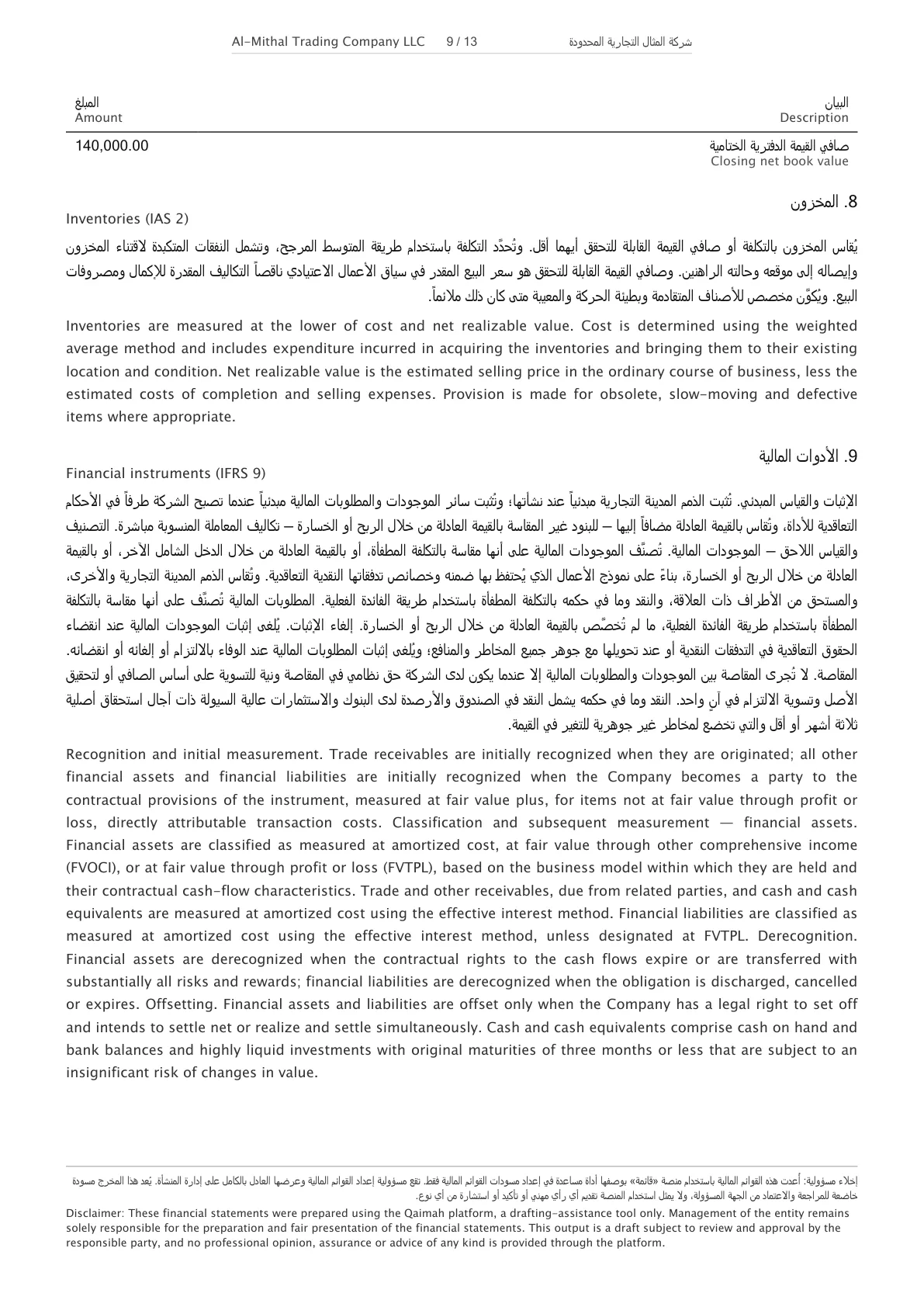
The notes
Notes are drafted from a policy library tied to the standards — inventories (IAS 2), financial instruments (IFRS 9), revenue (IFRS 15), zakat, and end-of-service benefits — and only those whose conditions hold for this entity's figures appear, in your firm's wording where you have changed it.
The figures are computed in code
No language model produces or alters any figure in the statements. AI is confined to suggesting an account's classification and reading the column headers of an uploaded file, and both remain editable before approval.
A validation battery before anything is produced
Trial-balance balance, rollup integrity, the financial position balancing, equity reconciling with the statement of changes, and the cash flow tying out — a material failure blocks generation and explains itself rather than shipping a set that does not balance.
Built for the Saudi environment
Zakat or income tax by ownership structure, the statutory reserve at the rate and cap set for the entity's legal form, end-of-service benefits as a non-current liability, and the commercial registration number on the cover.
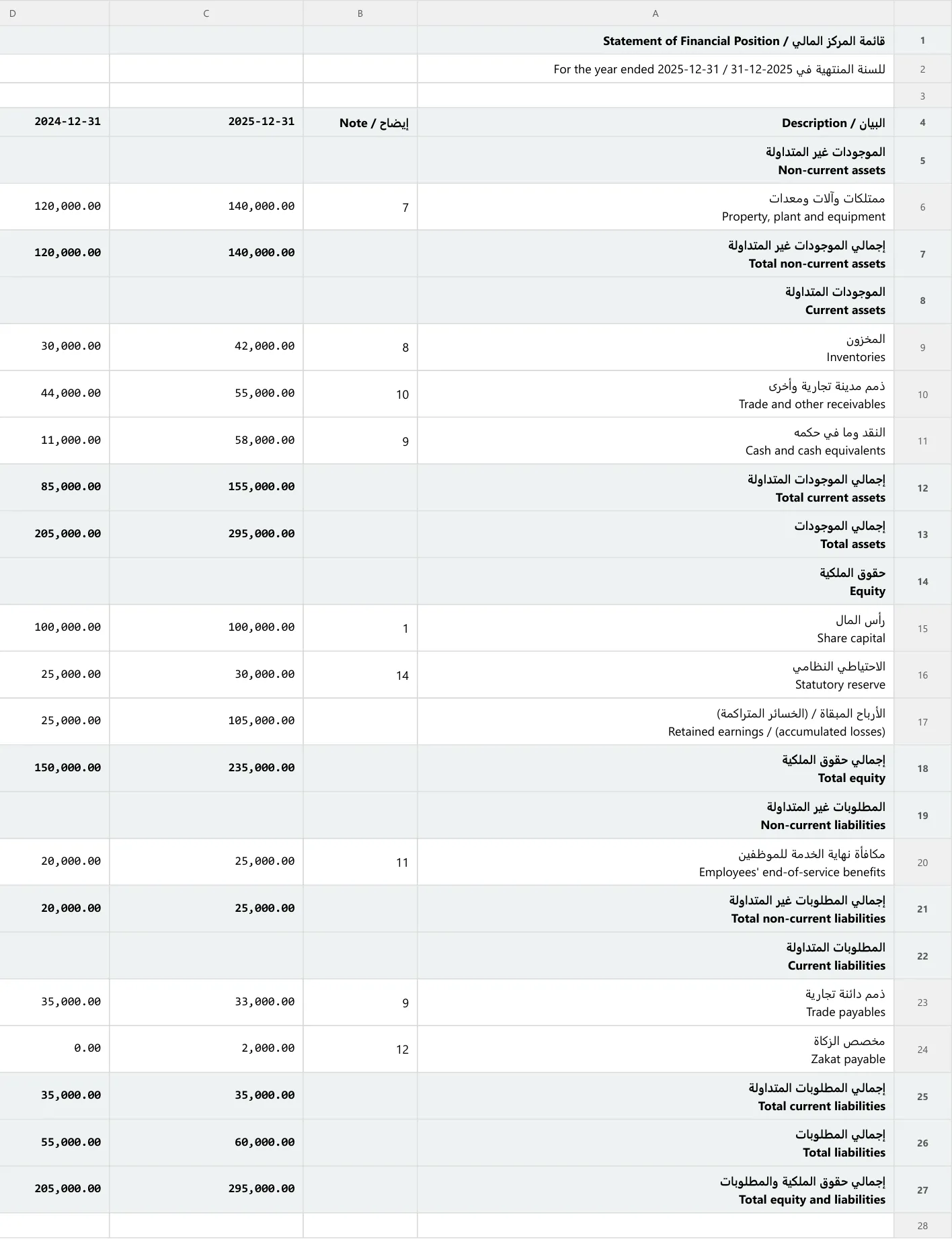
The same set in Excel
A workbook you can audit rather than a picture of one: bilingual captions in the same cell, amounts as numeric values under one display format, the comparative year beside the current one, and a sheet per statement.
Who it is for
Who it is for
Audit and accounting firms
In-house finance teams
Sole practitioners
What Qaimah does not do
The most useful thing to tell a profession that carries legal responsibility is where the tool stops. These limits are written into the platform's own output, not only here.
- It issues no professional opinion and no auditor's report, and provides no audit, review or assurance service.
- It does not approve the statements for you: every output is a draft, subject to review and approval by a qualified accountant.
- It does not repair an unbalanced trial balance or assume a missing figure — it refuses to continue and shows you where the problem is.
- It gives no zakat or tax advice, and replaces no disclosure that the entity's circumstances and your professional judgement require.
Common questions
Does Qaimah issue a professional opinion or an auditor's report?
No. The platform is a drafting tool only. It provides no audit, review or assurance service and issues no professional opinion; the report page in the output is left for the responsible party to complete.
Is the output final?
No. Every output is a draft subject to review and approval by a qualified accountant before any use, and the disclaimer appears on every page of every artifact and cannot be switched off.
Which reporting framework does the platform support?
IFRS as endorsed in the Kingdom of Saudi Arabia by the Saudi Organization for Chartered and Professional Accountants, in both versions: full IFRS and the standard for small and medium-sized entities.
What exactly does the AI do?
It suggests how an account maps to a line item where the deterministic rules are not enough, and reads the column headers of an uploaded file. It produces no figure in the statements and alters none, and every suggestion stays editable before approval.
How does the prepaid wallet work?
You top up your firm's wallet, and the balance is drawn down when the clean export for an engagement is unlocked. The full preview is available before that, so you never pay for an output you have not seen.
What happens to my clients' data?
It is processed solely to provide the service. It is never sold, never used for marketing, and never used to train a third party's AI models. The detail is in the privacy policy.
Try it on one engagement
Create an engagement, upload a real trial balance, and read the whole draft — every statement and every note — before you pay anything.